
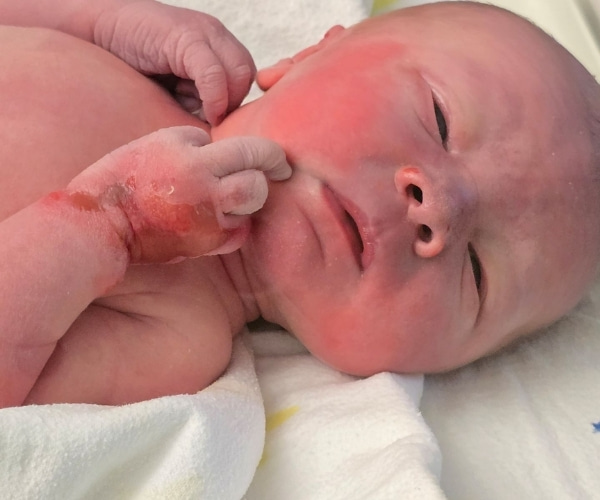
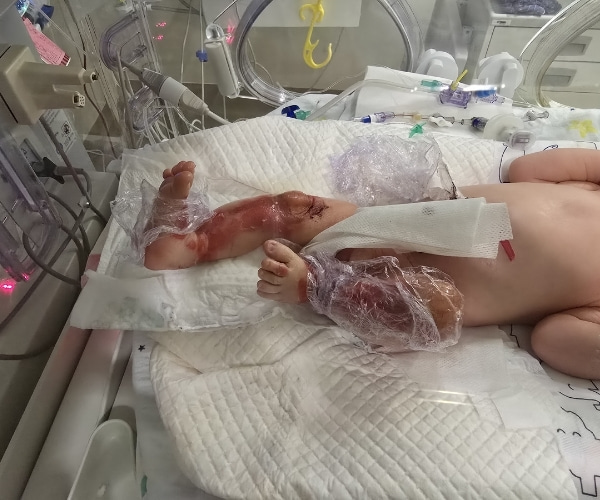
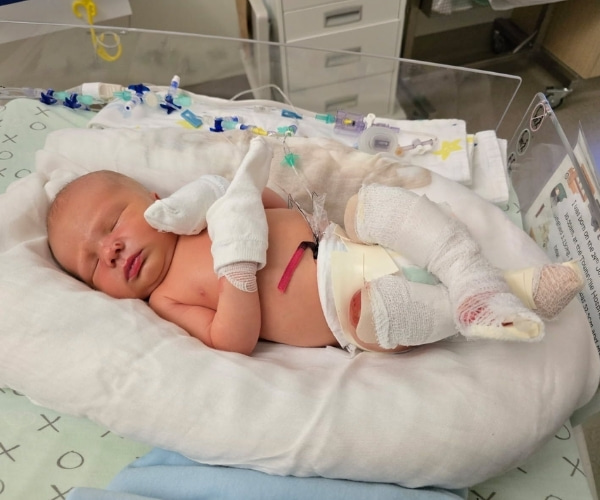
Meet Sydney: When Sydney was born in January 2025 at Townsville University Hospital, his parents knew immediately something wasn’t right. Large areas of skin were missing from his wrists, arms and the tops of his ears.
“The midwife said she’d never seen anything like it before,” his mum recalls.
Within minutes, Sydney was taken to the Neonatal Intensive Care Unit while doctors worked to understand what was happening. Because his skin was so fragile, they could not attach monitoring equipment in the usual way and instead used his umbilical cord for access. Sydney spent his first two weeks in NICU, lightly sedated to prevent further injury.
Jennii says: “My partner went with Sydney, and then when he came back he brought one of the NICU doctors, they explained they thought he had a skin issue, they weren’t sure what it was and they were going to get a dermatologist to see him. Because his skin was peeling away they couldn’t hook him up to any machines without going through his umbilical cord. They kept him lightly sedated so he wouldn’t pull the cords out. We didn’t see him for 5 hours as they were putting the cords in, it took that long. When we saw him they said we couldn’t pick him up, or rub him, we could just touch him gently.”
Doctors suspected Epidermolysis Bullosa (EB) on the day he was born, but they did not yet know which type. To be safe, they treated him as though he had the most severe form of the condition.
Over the following weeks, Sydney’s parents learned how to dress wounds, manage blisters and adapt everyday activities to protect his skin. When he was three months old, genetic testing confirmed he had EB Simplex 6, a rare form of EB caused by a spontaneous genetic mutation. Neither parent carried the gene.
A month after Sydney was born, the family travelled to Brisbane for their first EB clinic appointment. There they met DEBRA Australia staff and began learning about the support available, including access to specialised dressings, practical advice and connections to other EB families.
One of the most reassuring moments came when DEBRA Australia’s team connected Sydney’s mum with another family whose daughter has the same rare EB mutation.
“Knowing someone else with the same mutation was doing well was like a weight off my shoulders.”
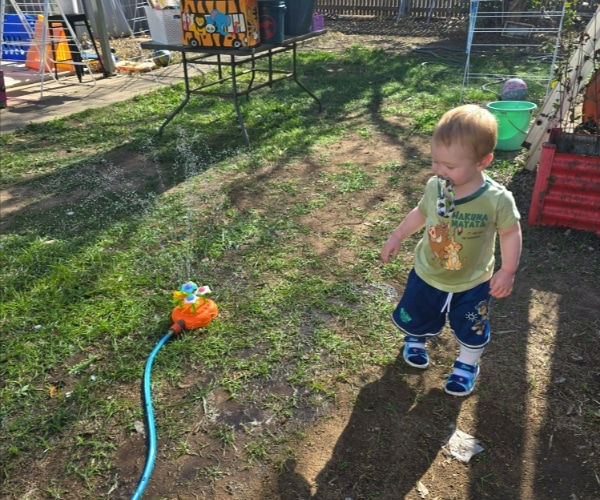
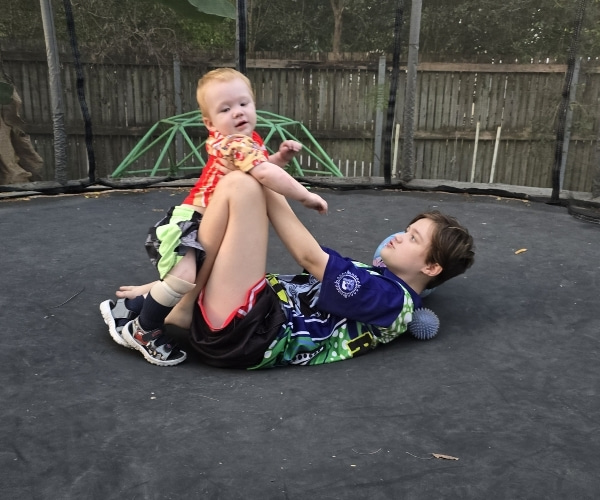
Today, Sydney is an active and determined little boy who is crawling and trying hard to walk. While his skin remains fragile, particularly during the hot Queensland summer and dry winter months, his family works constantly to reduce friction and prevent injuries. His car seat and pram have been modified with softer materials, and daily moisturising is essential to prevent his skin from tearing.
There are still challenges. A simple crawl across carpet or a playground surface can result in painful wounds and blistering. Dressing changes can be lengthy, and his older sisters often help distract him with toys and games while his parents care for his skin.
Despite this, Sydney continues to thrive.
His two big sisters are fiercely protective, quickly spotting any new blister and helping with his care. Recently, the family welcomed a new baby girl, who thankfully does not have EB.
Living in regional Queensland has highlighted just how rare the condition is. When Sydney was taken to hospital after a fall, Jennii says: “the doctor said to me when he came to see him was I’ve been told he’s got a skin condition I need you to explain it to me, and I said I thought as the doctor he’d know about it. And as it was a teaching hospital the doctor got all the other doctors and staff to come see it as a learning experience. That was when I really realised how rare EB is.”
Determined to raise awareness, Sydney’s family organised a Walk for Wings event in Townsville last year and plans to do so again this year. Through sharing their story, they hope more people will understand the realities of living with EB and the importance of support for families affected by this rare condition.
“We didn’t take photos at the start, I don’t know what was going through my head, I was crying all the time, and my partner didn’t want to take photos as he didn’t want to remember him like that, but a doctor came and told us she had something wrong with her when she was a baby and her mum took photos and it really helped her. So I started taking photos every day to remember everything.”
From a newborn covered in bandages to a little boy exploring the world around him, Sydney’s journey is one of resilience, determination and hope. With the support of family, healthcare professionals and the EB community, his future looks bright.